
First Patient in Live AI Assisted Sight-Saving Brain Surgery using OASIS technology
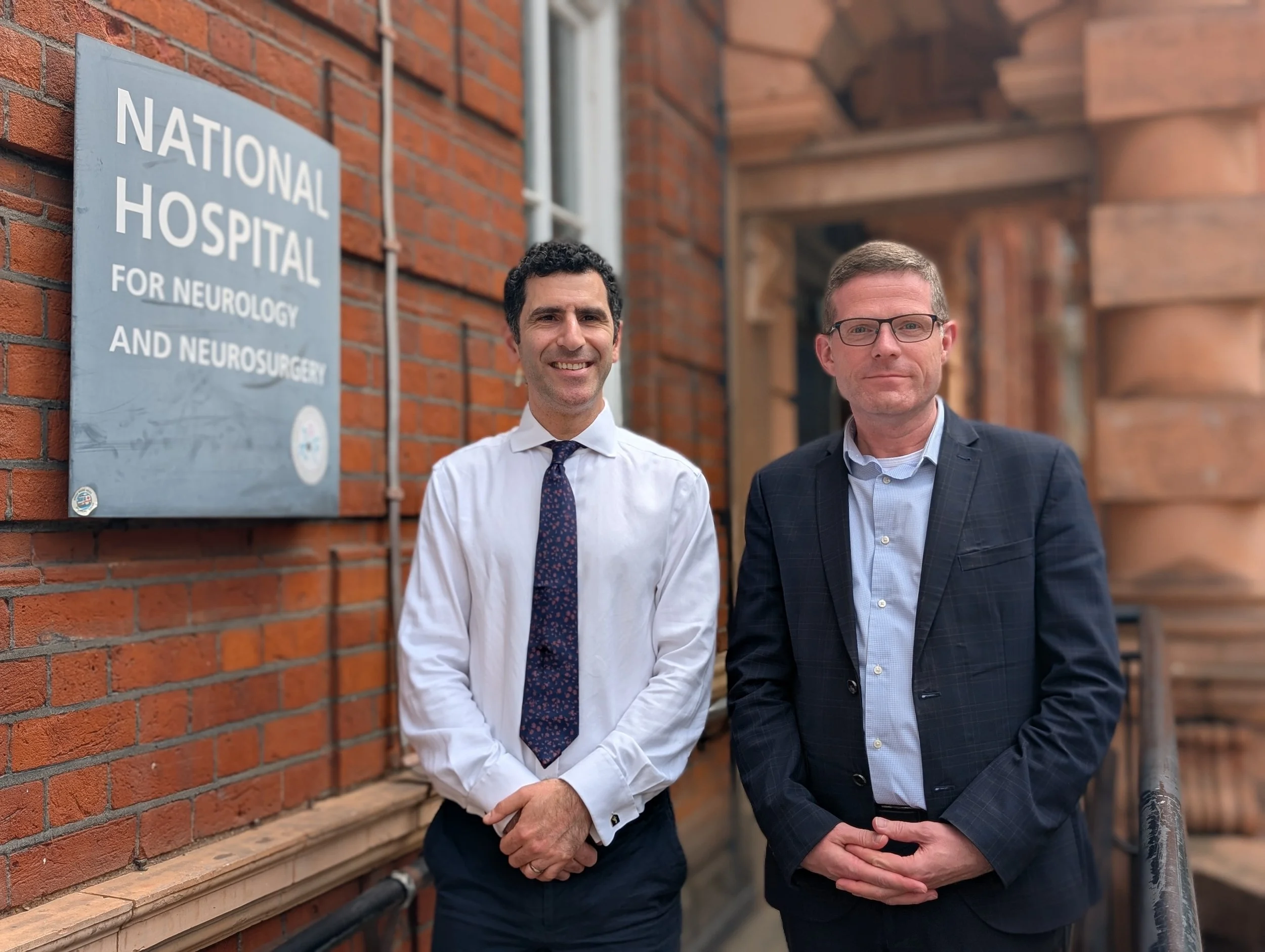
Prof Hani Marcus with Rhys Hibbert
The first use of Artificial Intelligence to support a neurosurgeon in real time during live surgery has protected the sight of a man having a brain tumour removed.
The operation was carried out at the National Hospital for Neurology and Neurosurgery (NHNN), UCLH, as part of a clinical trial using AI technology developed by the OASIS Hub and funded by the National Institute for Health and Care Research (NIHR).
Rhys Hibbert aged 48 from Bedfordshire, a Customer Services Manager and active Community Volunteer, is the first patient to have surgery in this way. Without surgery, Rhys’ tumour would have continued to threaten his sight and could ultimately have led to blindness. The operation successfully removed the tumour and protected his vision.
During his operation, the AI analysed the live surgical video feed in real time, rather than using pre-surgery scans, to help the surgical team make more precise decisions by highlighting critical structures at the base of the brain.
In this part of the brain, the pituitary gland (the size of a marble), blood vessels and nerves controlling vision are tightly packed together, and going a millimetre wrong can make a critical difference and lead to death, blindness or stroke. The AI supported the surgical team helping identify risky areas to avoid while removing as much tumour as safely possible. It also has the potential to track surgical instruments and instrument–tissue interactions, with the aim of supporting surgeons during complex procedures and provide feedback.
Rhys said learning and research is very important to him and described the experience as both “humbling” and “fitting” for a hospital with a long record of medical innovation.
The National Hospital for Neurology and Neurosurgery was founded in 1859… and was the world's first dedicated neurosurgical hospital. So to me, it seems very fitting that the same hospital should also be the world's first to carry out an AI‑assisted neurosurgery. I'm very pleased to have had the opportunity to be cared for in the hospital… I'm also very humbled to have been asked if I'll be prepared to be the world's first patient in this research.
Prof Hani Marcus, OASIS Hub investigator, consultant neurosurgeon at the NHNN, UCLH and Professor of Neurosurgery at the UCL Hawkes Institute, performed this first AI assisted surgery alongside Danyal Khan, the surgical resident leading the work.
Hani said:
Huge thanks to the trial participants and to the team committed to improving patient outcomes by taking this important first step globally and using UK homegrown AI to help reduce risk during these delicate surgeries.
The AI system was developed within the OASIS Hub, a multidisciplinary research group at UCL focused on advancing healthcare technologies. The system runs on an NVIDIA Clara IGX platform designed to support real-time AI in medical device settings.
Researchers trained and evaluated the system using a large collection of annotated endoscopic pituitary surgery videos from previous operations. The technology has previously been evaluated and used as a training tool for surgeons carrying out this procedure.
Dr Sophia Bano, OASIS Hub member and Associate Professor in Robotics and Artificial Intelligence at the UCL Hawkes Institute, who is technical lead for the AI system, said:
This AI system was developed by a multidisciplinary team at UCL. By learning from hundreds of surgical videos, it has been exposed to a breadth of surgical examples that would take a surgeon many years to encounter. It is designed to help recognise critical anatomy, surgical instruments and tissue interactions in real time, supporting the surgeon during highly delicate procedures.
The trial was funded by NIHR and Google. It was supported by the NIHR Biomedical Research Centre at UCLH, Royal College of Surgeons, Engineering and Physical Sciences Research Council and Wellcome.
Rhys's story
Rhys volunteered to be the first ever patient to have a pituitary tumour removed in this way.
Rhys, 48, an Ambulance Volunteer hasn’t been able to actively respond to 999 calls for the past 12 months, but he is still very much part of the team, keeps up with training and is determined return following his recovery.
Tumour discovered after sudden collapse
Rhys’s condition was discovered by chance in December 2024 when he collapsed during a walk and suffered a seizure.
My tumour was discovered unexpectedly in December 2024. I was out on my usual daily walk when I suddenly felt unwell and lost consciousness. Thankfully, people nearby were quick to help and I received immediate assistance. Following hospital tests, doctors discovered a tumour measuring around 11 millimetres in my pituitary gland. It was the only seizure I've ever had, and that unexpected event marked the beginning of my pituitary journey.
Subsequent tests revealed a tumour on his pituitary gland. Initially managed without surgery, his symptoms worsened over time, including severe hormone imbalance and vision problems.
Describing how he lost peripheral vision Rhys said: “I began using walking sticks after repeatedly tripping because I couldn’t see the lower field of visions.”
Choosing surgery — and research
Rhys opted for surgery and so volunteered to take part in research, driven by his belief in the importance of patient involvement and in part informed by his own involvement in the health system.
If patients are not prepared to join research how can doctors ever learn and how can medicine ever progress? To me, it's a really important and vital part of what these top specialist hospitals do.
Days before the operation, he was invited to take part in a live AI‑assisted procedure.
Asked if I would be prepared to be the world's first patient to have this technology used live… I said, yes, of course.
Vision restored within days
Rhys said that upon waking from surgery, his vision had dramatically improved.
When I came round… I could see everything in the room clearly.
Within a week, he was walking independently without glasses or sticks.
“It feels like I've got a 360‑degree panoramic view of everything around me,” he said—something he had not experienced for more than a year.
He acknowledged the risks involved in operating so close to the optic nerves:
There is a risk… that a patient will come out with worse vision. But I think my vision is testimony to their accuracy.
How AI supported the surgery
While the surgeon remained in full control, the AI system analysed live camera footage during the procedure, helping identify critical structures such as nerves and blood vessels.
From a patient safety perspective I can see absolutely the benefit. There are no road signs inside our head.
A gesture for the unseen team
Ahead of his operation, Rhys made a point of recognising those working behind the scenes. He brought two boxes of chocolates into theatre and handed them to the anaesthetist.
It's not down to me. It's down to the team of surgeons, the anaesthetists, and indeed the whole team of support staff… that make this sort of achievement possible. There are sometimes as many as 20 people in one theatre… and yet they deserve thanks too.
Looking ahead
Now recovering at home, Rhys is gradually rebuilding his strength and building the length of his daily walks. He hopes his participation will contribute to future advancements.
“Otherwise, how do we learn?” he said.